Expert articles, clinical guides, and manufacturing insights from BHW Medical Equipment Co., Ltd.
Connecting healthcare professionals and distributors with reliable orthopedic resources.
Medical compression stockings are becoming a more considered purchase for hospitals, clinics, retailers, and individual users worldwide. Grand View Research estimates that the global compression therapy market reached approximately USD 4.1 billion in 2023. Fortune Business Insights also projects continued growth through the decade, although market figures differ between reports. That gap deserves attention. Different definitions, regions, and product categories can change the results.
For global buyers in 2026, “best” should not mean the most expensive pair. It should mean suitable pressure, reliable sizing, durable fabric, and verified manufacturing quality. A stocking should feel supportive, not painfully tight. The ankle area should fit smoothly, without rolling or leaving deep marks. Buyers should also check pressure classes, usually measured in mmHg, and seek clinical advice when circulation problems, diabetes, wounds, or unexplained swelling are present.
The late vascular surgeon John J. Bergan described compression therapy as “the cornerstone of treatment for venous disease.” His statement still matters. Yet product choice is rarely simple. Foot shape, climate, washing habits, and donning ability can change the user experience. A breathable knee-high may suit a hot market, while a stronger thigh-high may require professional fitting. No ranking is perfect. This guide compares Medical compression stockings through clinical relevance, international quality signals, comfort, material performance, and buyer value. It also questions attractive claims that lack transparent testing. Sometimes, the cheaper option performs better. Sometimes, it does not.
Medical compression stockings in 2026 are commonly specified by ankle pressure, measured in mmHg. The range may start at 15–20 mmHg and reach 40–50 mmHg. However, these numbers are not automatically equivalent across countries.
Under the RAL-GZ 387 framework, Class I usually provides about 18–21 mmHg. Class II covers approximately 23–32 mmHg, while Class III reaches 34–46 mmHg. Class IV generally begins at 49 mmHg. This creates an important purchasing issue: a stocking labeled 40–50 mmHg may overlap Class III and Class IV, depending on testing methods and tolerance limits.
Pressure decreases upward.
The International Compression Club recommends selecting compression according to the medical condition, limb shape, skin status, and arterial circulation. The 2021 Cochrane review on venous leg ulcers also found that compression improves healing compared with no compression, although results vary by pressure and patient suitability. Higher pressure is not automatically better. It can cause discomfort, numbness, or skin damage when applied incorrectly.
In practical fitting, measure the ankle early in the morning, before swelling increases. Check the heel, calf, and upper edge for folding. Buyers should request test reports, pressure-class documentation, material composition, and washing stability. RAL-GZ 387 is useful, but certification alone does not replace clinical assessment. Size charts can still mislead, especially for short legs or irregular swelling.
2026 Best Medical Compression Stockings for Global Buyers
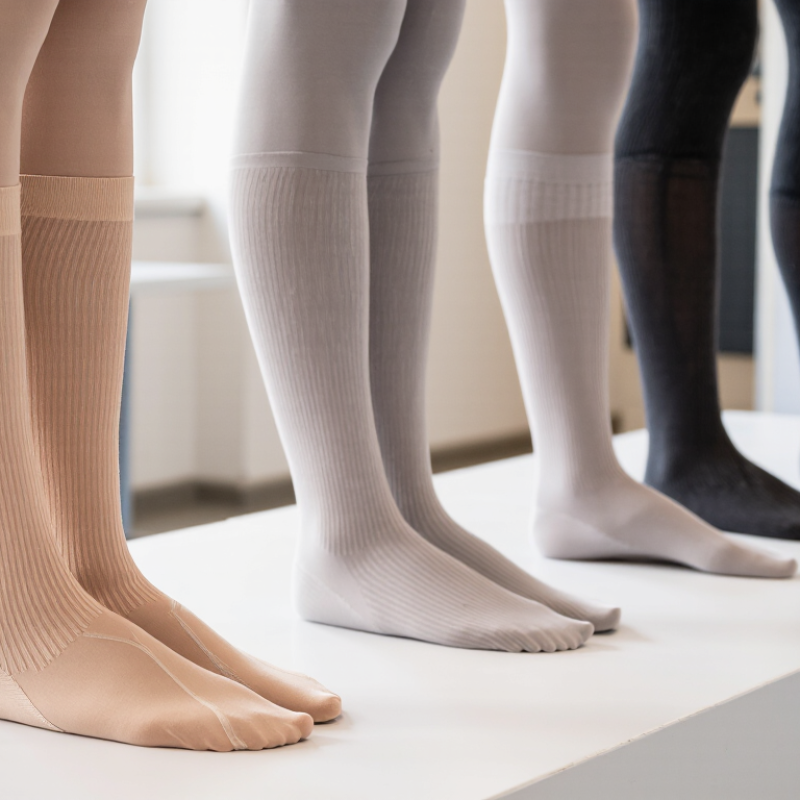
Graduated pressure is the defining feature of medical compression stockings. Pressure is highest at the ankle, then gradually decreases toward the calf and thigh. This gradient supports venous return when blood must move upward against gravity. The 2022 European Society for Vascular Surgery guidelines recognize graduated compression as a key option for chronic venous disease. A 2021 Cochrane review assessed 13 studies involving 2,918 airline passengers. It found that compression stockings reduced symptomless deep-vein thrombosis, although the evidence certainty remained low.
For global buyers, ankle pressure needs careful interpretation. A label showing 20–30 mmHg usually describes the ankle range, not equal pressure across the stocking. Higher is not automatically better. People with suspected arterial disease, reduced sensation, or poorly controlled diabetes should seek clinical assessment first. In fitting practice, accurate ankle and calf measurements often matter more than choosing a fashionable height. Morning measurements may be more reliable because swelling is usually lower. Still, sizing systems vary between markets, which can create avoidable mistakes.
Tips: Check the pressure unit, size chart, and medical standard before purchase. The heel should sit flat, without twisting or wrinkles. Remove the stocking if toes become cold, pale, numb, or painful. Skin marks can happen, but persistent discomfort deserves review. The honest limitation is simple: product data cannot replace vascular assessment.
| Compression Category | Typical Pressure at the Ankle | Typical Pressure at the Calf | Typical Pressure at the Thigh | Common Use | Recommended Product Height | Key Buying Considerations |
|---|---|---|---|---|---|---|
| Light support | 8–15 mmHg | Lower than ankle pressure | Lower than calf pressure | Leg fatigue, mild swelling, prolonged sitting or standing, and everyday travel support | Knee-high for most routine applications | Choose breathable fabric, a comfortable top band, and accurate ankle and calf measurements. |
| Moderate support | 15–20 mmHg | Progressively reduced | Progressively reduced | Mild varicose-vein symptoms, dependent swelling, and travel-related leg discomfort | Knee-high; thigh-high when swelling extends above the knee | Look for a clearly stated pressure range and a size chart based on ankle circumference. |
| Medical compression, lower range | 20–30 mmHg | Lower than ankle pressure | Lower than calf pressure | Clinically prescribed management of venous disease, edema, or more significant varicose veins | Knee-high, thigh-high, or waist-high according to clinical need | Obtain professional guidance, especially for first-time users or people with circulation problems. |
| Medical compression, higher range | 30–40 mmHg | Progressively reduced | Progressively reduced | Selected cases of severe venous disease, significant edema, or post-treatment care | Product height should match the area requiring compression | Use only with appropriate clinical assessment and fitting; donning aids may be helpful. |
| Graduated pressure profile | Highest pressure | Lower than ankle | Lower than calf | Supports upward movement of venous blood and helps limit pooling in the lower leg | Any height, provided the graduated profile is maintained correctly | The ankle value should be clearly identified; compression should decrease gradually toward the top. |
| Uniform compression profile | Similar pressure across the garment | Similar pressure across the garment | Similar pressure across the garment | General support garments where graduated medical compression is not required | Knee-high or other height based on coverage needs | Do not treat uniform compression as equivalent to graduated medical compression. |
| Knee-high stocking | Maximum pressure normally occurs at the ankle | Reduced pressure toward the knee | Not applicable | Common choice for lower-leg swelling, travel, standing work, and many venous-support applications | Ends below the knee without rolling or cutting into the skin | Measure ankle and calf circumference plus leg length; confirm the top band remains flat. |
| Thigh-high stocking | Maximum pressure normally occurs at the ankle | Reduced pressure above the ankle | Lower pressure near the thigh opening | When swelling or symptoms extend above the knee | Reaches the upper thigh without slipping | Check thigh circumference, silicone-band comfort, and whether the garment stays in position during movement. |
| Waist-high stocking or pantyhose | Maximum pressure normally occurs at the ankle | Progressively reduced upward | Reduced pressure through the thigh and hip area | When bilateral symptoms or swelling require coverage above the thigh | Extends to the waist | Confirm waist, hip, thigh, calf, ankle, and leg-length measurements before ordering. |
| Open-toe design | Uses the same stated compression class as the selected garment | Graduated reduction remains necessary | Graduated reduction remains necessary | Accommodates toe sensitivity, foot-shape preferences, or easier visual inspection of the toes | Knee-high, thigh-high, or waist-high | Check that the foot opening does not bunch, pinch, or create pressure around the toes. |
| Closed-toe design | Uses the same stated compression class as the selected garment | Graduated reduction remains necessary | Graduated reduction remains necessary | Provides full foot coverage and may be preferred for warmth or daily wear | Knee-high, thigh-high, or waist-high | Allow adequate toe room and select a fabric suitable for the intended climate. |
| Breathable daily-wear fabric | Must match the declared compression class | Must decrease gradually from the ankle | Must remain lower than the ankle pressure | Warm climates, office use, travel, and extended daytime wear | Usually knee-high | Review fiber content, moisture management, seam placement, and washing instructions. |
| Post-treatment or clinical-use garment | Specified by the treating professional | Specified by the treating professional | Specified by the treating professional | Use after a vascular or lymphatic assessment when compression is clinically indicated | Determined by the treated area | Verify the prescription, fitting method, pressure class, replacement schedule, and follow-up requirements. |
For global buyers comparing medical compression stockings in 2026, ankle-brachial index screening should come before product selection.
ABI compares ankle and arm blood pressure. A result below 0.5 commonly signals severe peripheral artery disease risk and possible tissue ischemia.
Do not treat it as a routine sizing issue.
The 2024 ACC/AHA Peripheral Artery Disease Guideline recognizes ABI as a key diagnostic test, with values at or below 0.90 considered abnormal. Clinical compression protocols often advise avoiding therapeutic compression below 0.5 unless a vascular specialist directs care.
A 2015 Global Burden of Disease analysis estimated peripheral artery disease affected more than 236 million adults worldwide.
The burden is substantial, and symptoms may be quiet.
Cold feet, pale toes, weak pulses, or a small wound that heals slowly deserve prompt assessment.
Stockings can increase external pressure around the limb. That may support venous return, but it can also worsen arterial insufficiency when blood flow is critically reduced. The boundary is not always tidy.
Diabetes, calcified arteries, swelling, and inaccurate cuffs can distort ABI results. Buyers should request measurement by trained clinicians, confirm the reading, and consider toe-brachial index testing when arteries appear noncompressible.
Products should be chosen only after reviewing circulation, skin condition, intended pressure class, and fit.
A lower pressure is not automatically safer.
In severe PAD, unsupervised compression may create harm.
2026 Best Medical Compression Stockings for Global Buyers
Global sizing is not truly global. A medium in one chart may differ from a medium elsewhere. Always compare your measurements with the seller’s current chart.
Measure both legs in the morning, before swelling increases. Stand naturally, or ask another person to help. Wrap a flexible tape around the narrowest ankle area, just above the ankle bone. Keep the tape flat and comfortably close. Do not pull it tight. Measure the widest part of the calf next. For thigh-high stockings, measure the fullest part of the thigh. Record each result in centimeters and inches. Small errors can change the recommended size.
Measure carefully.
For consistent results, repeat every measurement twice. If the legs differ, use the larger circumference unless a qualified clinician advises otherwise. Length matters too, although circumference usually determines the primary size. Check where the stocking should end, then compare heel-to-knee or heel-to-thigh length with the chart. Compression levels also require professional guidance, especially for people with circulation problems, diabetes, skin conditions, or unexplained leg swelling. A useful fitting lesson is that tighter does not mean better. Wrinkling, numbness, cold toes, or deep marks suggest a poor fit. Charts are helpful, but they are not perfect. A trained fitter or healthcare professional can identify problems that numbers alone may miss.
2026 Best Medical Compression Stockings for Global Buyers
Quality Verification: Compare ISO 20696:2018, RAL-GZ 387, and FDA Rules
Global buyers should not treat ISO 20696:2018, RAL-GZ 387, and FDA requirements as interchangeable. ISO 20696:2018 focuses on medical compression hosiery, including performance, sizing, materials, and manufacturing controls. Request the complete test report, not only a certificate image. Check pressure values at the ankle, size range, durability results, and testing laboratory details.
RAL-GZ 387 represents a strict German quality framework for medical compression stockings. It commonly addresses defined compression classes, pressure distribution, fit, and repeated-use performance. Ask whether testing covered finished stockings, not just fabric samples. A stocking can feel firm in the hand and still deliver uneven pressure on the leg. That difference matters.
FDA review follows the product’s intended use and medical claims in the United States. Some compression products may require device clearance, registration, listing, or specific labeling controls. Registration alone does not mean FDA approval. Verify the product classification, clearance status when applicable, manufacturing information, and instructions for use. Also compare wash-cycle results and batch traceability. No standard answers every question. A polished document can hide weak sizing data. Buyers should record these gaps and request clarification before placing a large order.
Ankle pressure commonly ranges from 15–20 to 40–50 mmHg. Pressure decreases upward. Higher pressure is not automatically better.
No. It may overlap two higher compression classes. Testing methods and permitted tolerances can change the result. Labels get messy.
A trained clinician should review circulation, swelling, skin condition, limb shape, and the intended pressure. Fit alone is insufficient.
It compares ankle and arm blood pressure. A result below 0.5 may indicate severe arterial disease risk. Unsupervised compression can cause harm.
Cold feet, pale toes, weak pulses, or slow-healing wounds need attention. These signs can appear quietly. Do not ignore them.
Measure the ankle early in the morning, before swelling increases. Check the heel, calf, and upper edge. Folding can create uneven pressure.
Request pressure test results, compression-class details, material composition, washing stability, and laboratory information. Ask whether finished stockings were tested.
No. Certification supports quality review but does not replace clinical assessment. A polished document may hide weak sizing data. That deserves checking.
Compare pressure accuracy, sizing, materials, manufacturing controls, durability, labeling, and batch traceability. Registration does not always mean product approval. Ask again when unclear.
This guide to Medical compression stockings helps global buyers understand how to evaluate products in 2026. It explains compression levels ranging from 15–20 to 40–50 mmHg under RAL-GZ 387 and describes graduated pressure design, in which compression is strongest at the ankle and gradually decreases up the leg. This structure supports controlled circulation and should be matched to the user’s clinical needs rather than selected by appearance alone.
The article also highlights the importance of clinical screening before use. An ankle-brachial index below 0.5 may indicate severe peripheral arterial disease risk and requires professional assessment before compression therapy. For accurate international sizing, buyers should measure ankle, calf, and thigh circumference according to the product’s fitting instructions. Finally, quality verification should compare relevant requirements from ISO 20696:2018, RAL-GZ 387, and applicable FDA rules, including labeling, performance, safety, and documentation.